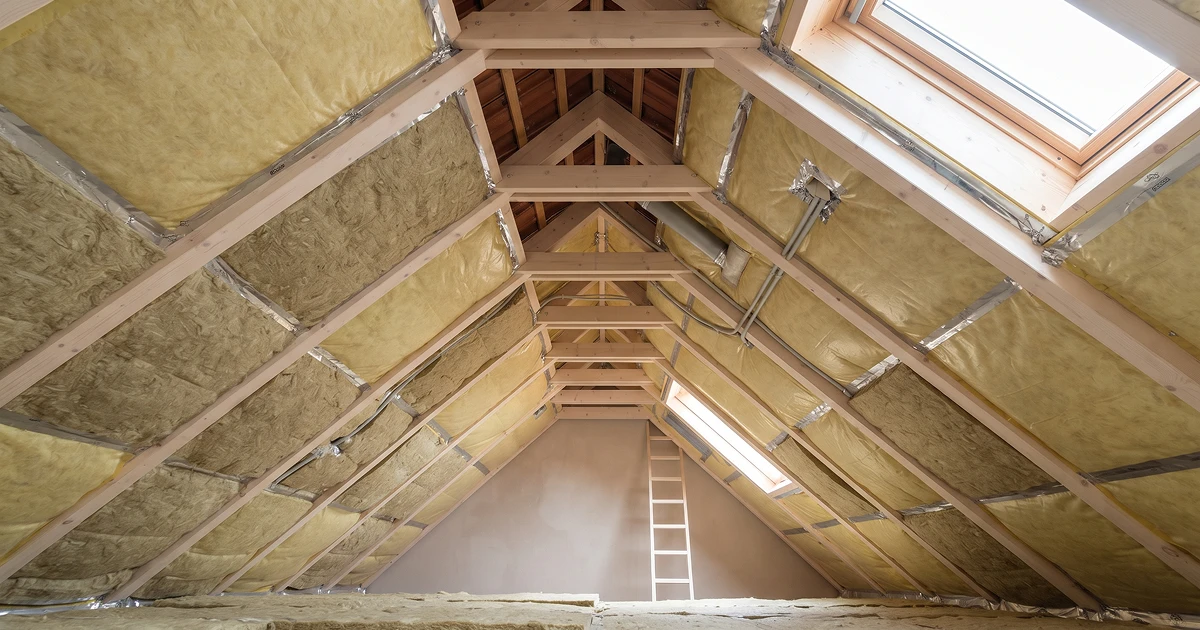
Thick insulation is not enough on its own
When we refurbish a roof, one of the first questions is usually how thick the insulation should be. The thicker the better, one might think.
That, however, is only part of the story.
In a roof that works well it matters not only that it keeps the warmth in during winter, but also that the moisture forming within the construction does not cause problems later on.
The air inside a home always contains a certain amount of moisture. Cooking, showering, drying laundry – even our breathing – all add moisture to the air. This warmer, more humid air then tries to move onwards through the building fabric as well.
If that moisture cannot move properly and dry out of the construction, over time it can cause serious problems.
What happens to the moisture inside a roof?
The air inside a heated space is generally warmer and more humid than outside. Moisture therefore tends to travel from the warmer side towards the colder one.
In itself that is a perfectly natural process. The trouble starts when it reaches a cold surface inside the construction, where the air cools down and the moisture it carries condenses.
We see a similar phenomenon when condensation settles on cold glass. But while we notice it immediately on a window, in a roof the moisture can stay hidden for a long time.
As a result, the performance of the insulation can deteriorate, mould or fungal growth can appear, and the timber structural elements can be damaged too.
Vapour barrier or vapour check?
The two are not the same.
A vapour barrier very largely prevents water vapour from entering the construction, while a vapour check restricts – but does not completely stop – the movement of moisture.
Which one is needed cannot simply be decided out of habit. The whole build-up has to be examined: what the insulation is, what the outer covering is, whether there is a ventilated cavity, which membranes go into the construction, and what the internal lining is.
It is therefore unwise to say of a roof simply that “let’s put a vapour barrier in”. The membrane on its own solves nothing if it is placed in the wrong position, or if the rest of the build-up does not allow the construction to work properly.
Breathability matters just as much
From the other direction, it also has to be ensured that any moisture that does get into the construction can find its way out again.
That is why vapour-permeable layers and ventilated roof constructions are so important.
A well-designed roof is not necessarily entirely free of moisture. It is much more a roof in which the movement of moisture is controlled and the construction is able to dry out.
This is particularly important when refurbishing older roofs. It is not enough to look at how much insulation will fit between the rafters. The existing build-up also has to be examined and, where necessary, rethought.
Where the membrane goes is not indifferent either
During a roof refurbishment various membranes come up. There are vapour barriers, vapour checks and vapour-permeable membranes.
They are not interchangeable, and it matters a great deal which one goes where.
There is no point buying a good-quality product if it is built into the wrong position. It can equally cause problems if the membrane is not properly lapped and sealed, or if gaps are left at junctions and penetrations.
A single poorly sealed cable or pipe penetration can undermine the performance of the vapour check.
With a roof, therefore, it is not worth looking at any one material in isolation. The whole build-up has to work together.
Workmanship matters at least as much as the material
Even the best membrane will not perform if it is badly installed.
The vapour barrier or vapour check has to be properly continuous. Laps, junctions and penetrations must be formed and sealed with care.
This often looks like a minor detail, yet it can be of great consequence.
With a roof, then, it is not only the quality and thickness of the material that counts – the correct build-up and careful workmanship matter at least as much.
Particularly important in a refurbishment
Refurbishing an older roof raises a number of questions:
- What is already in the roof?
- What condition is the timber in?
- Is there an existing membrane?
- Is the construction properly ventilated?
- Where will the new insulation go?
- What happens to the existing layers?
These should not be brushed aside simply because we want to fit as much insulation as possible.
With a poorly considered build-up it is all too easy to end up insulating more while building a moisture problem into the roof.
Not every roof is the same
Different considerations arise for a cold loft floor, an inhabited loft conversion, insulation between rafters or a roof insulated from the outside.
Before a refurbishment, therefore, it is worth asking not only “how thick should the insulation be?”, but also:
- which way can the moisture travel,
- where is the vapour check or vapour barrier,
- how can the construction dry out,
- is ventilation provided,
- do the individual layers connect properly to one another.
In a roof that works well, the insulation, the vapour check, the breathability and the ventilation form a single system.
A good roof does not just keep you warm – it handles moisture properly too.
In a roof refurbishment, therefore, it is not worth deciding where the membrane and the insulation go part-way through the works. The build-up should be thought through at the design stage.
Because in a roof a great deal can be invisible to the eye – including the problems.
And by the time damp or damage to the timber becomes visible, the process will often have started a good deal earlier.